1. Causes of mastitis
- Bacterial infection: The primary cause of mastitis is bacteria such as Streptococcus agalactiae, Staphylococcus, and pus-producing bacteria like Bacillus pyogenes, E. coli... These bacteria are always present in the farming environment, milking equipment, etc., and then invade the cow's body. It can also be secondary to other diseases such as tuberculosis, viral diseases like foot-and-mouth disease...
- Structural factors of the udder: Overly large udders and elongated teats, oversized teat openings prone to leakage, abnormalities in the udder and teats. Older cows, long-term milk production, early lactation period, and dry period make cows susceptible to mastitis.
- Environmental factors: Poor hygiene in farms, dirty and damp bedding, lack of ventilation, insufficient light. Stressors like noise, inadequate cow care practices, high stocking densities... Especially, high temperatures and humidity can induce heat stress in dairy cows.
- Poor milking techniques, inadequate hygiene: Milk extraction methods, timing, frequency, pressure. Poor udder hygiene, unclean milking equipment, improper sanitation procedures before milking. Dirty barn floors, lack of dedicated milking areas.
- Nutritional factors: Rapid dietary changes causing stress => mastitis. Imbalanced diet (excessive grain, legumes, deficient in vitamin E and selenium). Feed contamination with bacteria, fungal toxins... Poor quality and quantity of drinking water.
2. Symptoms
Image 2: Symptoms
- Loss of appetite, fever (40-41°C), inflamed, swollen, red, hot, firm udder, difficulty to milk or cessation of milk secretion, pain upon palpation.
- Abnormal milk, thinner or appearing diluted. Milk can be lumpy, with colors like yellow, green, brown, or slightly red.
- The pinkish milk due to hemorrhage or blood leakage, with milk clots.
3. Clinical diagnosis
* Visual inspection
- Observation of the symmetry of the udder quarters: 2 front quarters (right, left), 2 rear quarters (right, left).
- Size, shape of the udder, teats, teat ends.
- External skin conditions of the udder, such as tension, elasticity, wrinkles, swollen areas containing pus, blood, pimples, keratinized skin, and color variations (red, pink, shiny white,…).
- Shape of teats, teat tips and milk orifices.
- Development of blood vessels on the udder.
- Status and shape of the supramammary lymph nodes.
- Check supplementary areas such as: Inflammation of the supramammary lymph nodes behind the udder, light sensitivity.
- Front of the udder such as: Edema, pus on the skin, pimples, or blood blisters.
- Check the sides of the udder like: Swollen, red, or pus-covered areas near the thigh.
* Palpation
- Udder palpation is performed after all milk has been extracted, determining the condition of the udder, uniform size, and firmness.
- The condition of the milk ducts inside the teat (keratinization, thickening, softness).
- Milk cistern under the teat base.
- Mobility between the udder skin and the soft tissues underneath, checking elasticity, firmness of the udder skin.
- Checking the mammary gland lobules and any nodules, masses, or painful areas.
- Changes in the shape and size of the supramammary lymph nodes.
Pathological findings when palpating the udder
| Symptom Condition |
Pathological |
| Reduced skin mobility |
Edematous udder, acute mastitis, scar tissue udder |
Finger indentation remains on the
udder surface |
Udder edema, acute inflammation, or areas with
pus-filled abscesses |
| Hardened milk ducts |
Teat inflammation, cell hyperplasia, chronic mastitis |
| Asymmetrical udder quarters |
Udder shrinkage, acute mastitis of some quarters, abscesses, large blood clots |
| Internal udder masses |
Mastitis, abscesses or blood clots, hemorrhage |
| Hardened mammary gland tissue |
Chronic mastitis |
| Swollen supramammary lymph nodes |
Severe mastitis, abscess formation, tuberculosis
or leukocyte-related diseases |
Examination of milk quality and secretions
| Interpretation |
Normal milk |
Inflamed milk |
| Color |
White |
Reddish-pink, brown, green |
| Odor |
Characteristic, pleasant, cool |
Tangy, foul (similar to rotten eggs), sour |
| Viscosity |
Uniform |
Inconsistent, with lumps, clots, uneven
flow observed, layering. |
| Milk volume |
Abundant, corresponding to
milking frequency, time |
Reduced or absent depending on the
degree of inflammation |
4. Disease prevention
Conduct proper biosecurity farming, ensure hygiene, barn disinfection, implement the following steps:
* Proper milking practices
Before milking:
- Cows need to be cleaned and allowed to rest in a quiet space 30 minutes before milking.
- There must be a dedicated, clean, dry milking area, regularly disinfected.
- All milking equipment must be clean, disinfected or rinsed with boiling water.
- Milkers must wear clean clothes, wash hands with soap and thoroughly dry with a clean towel.
- Use warm, clean towels to clean cow udders before milking.
- Massage, stimulate the udder until it feels firm and ready for milking.
- Milk out a small amount of milk to increase fat content and reduce the risk of mastitis.
- Start milking healthy cows first, then sick ones. Discard the first few streams of milk into dark-colored trays or black cloth for observation of abnormal color or clots (never on the barn floor) then milk into specialized milk containers.
- Milk at regular intervals, three times a day for high-yielding cows, ensure complete milk extraction to stimulate milk secretion and reduce the risk of mastitis.
After milking:
- Dip teat ends in a disinfectant solution like
Five-Iodine.
- Clean all milking equipment with soap, rinse with boiling water for sterilization and air dry on racks.
- Do not allow cows to lie down immediately after milking, encourage them to stand to prevent direct contact of udders and teats with the barn floor.
* Farm
Build well-ventilated, cool areas with misting systems to prevent heat stress in cows, provide suitable exercise yards, keep the resting areas dry with padded bedding, clean and regularly disinfect barns with
Five-Iodine or
Five-Perkon 3S.
* Pest and parasite control for cows
- Use
Five-Tox 250 to spray and eliminate flies, mosquitoes in the barn and surrounding areas.
- Periodically administer
Five-Mectin100 every 3 months: deworming for internal and external parasites in cows.
- Or
Hado-Alben for oral deworming every 6 months to eradicate intestinal parasites.
* Proper nutrition
- Balanced diet meeting nutritional requirements, balanced roughage, greens and concentrates to prevent contamination with bacteria.
- Supplement with electrolytes, vitamins, minerals to enhance the immune system, thereby reducing mastitis rates:
Beta-Glucan.C,
Five-Mix,...
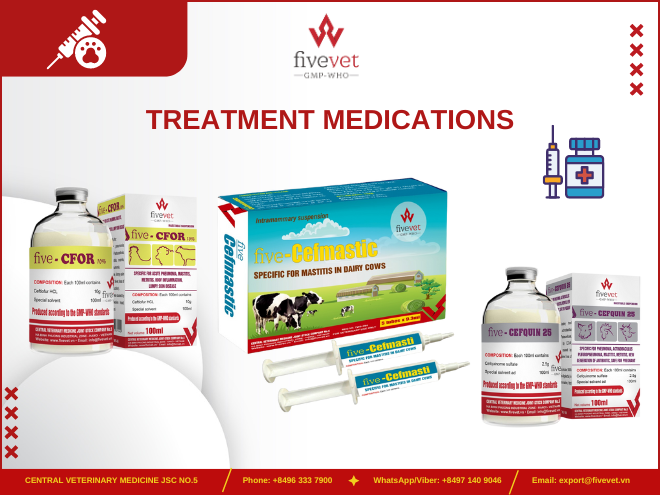 Image 3: Treatment Medications
5.1. Isolation, care
- Implement isolation of affected cows.
- Adjust feeding (reduce concentrates, increase water content).
- Strengthen infection control throughout the farm: Proper manure and waste management, daily collection and disposal. Severely affected cows that cannot recover should be culled.
5.2. Local treatment
- Massage the udder and apply hot compresses.
- Clean the udder, dip teats in
Five-Iodine disinfectant solution.
- Administer antibiotic infusion into the udder:
Five-Cefmasti: 1 tube/udder/day, for 3-5 days.
5.3. Systemic treatment
- Supportive care:
Five-Butasal,
Five-ADE Inj,
Five-Gluco.K.C.Namic,...
- Anti-inflammatory, antipyretic (if the selected antibiotic does not include these components):
Five-Ketofen (1ml/30kgBW) or
Five-Flunixin 5% (1ml/15kgBW),...
- Specific antibiotics, select one of the following products:
Five-Cefketo,
Five-Cfor 10%,
Five-Cefquin 25,
Five-Amox.20@LA,... Administer for 3-5 days. For weak cows, intravenous Glucose 5% or NaCl 0.9% can be administered along with oral rehydration solutions, depending on the ability to eat and overall condition.
Field Technical Department - Fivevet
 +84 963337900
  info@fivevet.vn
  Login
Login  VN
VN
 ENG
ENG


